Selasa, 24 Mei 2016

Giant by Aharon Applefeld Analysis

Giant is a short story which was written by a Jewish whose name is Aharon Appelfeld. He was an Israeli novelist who was born in Czernowitz, Romania which now is Ukrainne on February 16, 1932. The author was one of many Holocaust survivors during Nazi regime. The fact influences the author in writing the story. He tended to choose Hebrew language rather than his mother’s tongue, German, not only because his school used Hebrew but also because he had a subject matter or we so call trauma because of Holocaust. As we know during the Holocaust, thousands Jews were murdered by Nazi regime. In this story titled Giant, I think, Aharon Appelfed did not directly write the story which addresses to his personal life or experience, but he tended to make the readers who read the story to interpret the meaning of the whole story in various ways and point of views. Roth (1988) had interviewed Aharon Applefeld and stated that in the age of 14, in 1946 exactly, the author of Giant was moving from Romania to Tel Aviv which is near Jerusalem, Israel. The correlation between the year of his moving and the year stated in the beginning of the story is very significance. In 1946, Aharon Applefeld was a newcomer to the town name Tel Aviv in Jerusalem, he was just like a newborn baby who had the first time to see the real world, real world condition after Holocaust, of course. Then, it is just like Giant who was just born in that exact years.

The setting of place of this story is in Haifa. It is the third largest city in Israel which is located near a hill and beach. The significance of the setting place which is taken in Haifa is that the fact that his parents were survivor in the Holocaust. In 1945s many Holocaust survivors migrated from many camps where the Holocaust done by Nazi regime to a better place that they thought safe. The setting place in Haifa also proves that the father of the Giant was a Holocaust survivor that joined the migration also. Then, according to James and Jeffrey (1981: 43) the time of day or time of year at which a given event or series of events occurs can also contribute importantly to setting as well. In addition, the intention of the author in establishing the setting time and place is to make the reader see and feel the story, then because the location which is near a beach make the Giant became a good friend with the beach, because the condition a year after World War II was still not stable and bitter for the Jews who were the Victim of the Holocaust. Thus, it made the Giant liked sea which offered him closeness, silence, and repose.

His family background which shaped him become a strong, sturdy, and talk less. Both of his parents were tall and brawny, but they never caught up each other. The fact that they were living and surviving during the Holocaust conducted by Nazi regime. During the Holocaust, many Jews were sent into an extermination camp which is different with the concentration camp. Mostly, the concentration camps were located in German and some of them were deemed to be slave. In this case, his father became a slave worker in Auschwitz may because of his big body was fit with this kind of job. Auschwitz is an extermination camp built by Nazi to do mass killing. Unlike in the concentration camp in other place, camp in Auschwitz distinguished people who fit to work for exhaustion in order to produce the war logistic and who directly would be sent into gas chamber to be murdered by Nazi and its collaborators. The mother of him survived because she was hidden by a peasant during a war. She was strong and not easy to intimidate although his father revoke her every day in her entire life because she had been ever hidden by a peasant. Both of them seem like the real images of the Nazi and survivors. The father of him was survive in the Auschwitz and he became a slave worker that made him become very rough. On the other hand, his mother who never underwent the Holocaust because she was hidden by a peasant, so this fact shaped her become strong but silent. In this case, the author likes have intention to have a description between the cruelty of Nazi and the victim.

 https://commons.wikimedia.org
Camp Auschwitz

The story was narrated by first-person point of view. Besides the clear signal that this story uses the ‘I’. In addition, the I here as the first point of view retains the inside position, but goes one steps further by locating the point of view in a character who addresses the reader directly without an intermediary (James & Jeffrey,1981: 50). It is clearly significance that the first person of view or the Giant in this story directly knows the thought and feelings that reveal which are his own feeling.

In order to emphasize the detail of the story, the author used some of figurative language. First figurative language that used is personification, “The sea, my good and faithful friend, watched me over me,..” it seems that the sea has interactions with him. In my opinion, the usage of putting personification here is to give detail that the Giant was very close with the sea in term of emotion since in the beginning of the story it is stated that he used to go to the beach. The second figurative language is hyperbole. The function of this kind figurative language is to exaggerate the situation. The example of hyperbole is when the Giant describes how his father get furious towards his mother, “with an astonishing torrent of words.” The next example is when the Giant describes Mina who is quite and almost never said any word, “Every word she utters costs her blood.” The other figurative language used in this story is the metaphor which in this story stated, “They were bastioned,” it describes the physical appearance of the parents of him. The simile is also used in this story also, “The trucks seemed like my parents my parents to me: mute and dangerous,” it gives detail the reason why the Giant did not like them because they were like his parents who were sturdy and strong, but silent. The irony is stated when the Giant whose body size was bigger and unlike any other people had very small courage to tell, speak, reveal what he felt, or even to stand with a pressure. For example, he said, “I can’t stand with the pressure of the place.” The next example that can be looked at is when he did not have any bravery and idea what and how to express hid feeling for Mina.
The first issue which comes out from this story is a cultural issue. The parents of the Giant never let him to sell any inheritance, because selling it just will make the seller or the descents become poor. In the story it is stated by the saying of his father, “Whoever sells an inheritance will stand naked and bereft one day.” In Javanese culture, the people who break any dying exhortation will not have a good life after all. The inheritance itself is the symbol of responsibility, pursuance, and love. The heir should be responsible to always keep what the giver has given for any better. Then, it is the obligation of the heir in order to respect and obey the dying exhortation of the giver. From the parents point of view, inheritance is kind of symbol that they love their children by leaving them something useful to make their heir survive for the rest of life. In addition, in this case, the parents of the Giant did want him could survive by keeping the inheritance by himself. On the contrary, in fact, the Giant could not stand to keep the inheritance any longer. He always thought that he must had have a different path and way of life from what his father and mother had had. It seems that the Giant was not responsible and obedient. After his father and his mother died, he did not think deeply and he directly had strong eager to sell the trucks which were his parents’ inheritance. Whereas, his father had ever warned him that inheritance was an elixir of live, but he always ignored anything about the warning. The next symbol in the story are the trucks that inherit form his father and mother. It is also the reason why the Giant hated the truck because the trucks were tall, big, and sturdy but they are silence like his parents.
In many cases, the Giant’s characteristic who he was hasty and short thinking was revealed. He did not think any further what risks he might get after selling his father inheritance and how actually he had already made his father and mother disappointed. In addition, he had unstable convictions since he always shortly thought to quit his jobs. In this case, the Giant’s characteristics also influenced by his family’s condition. His father and his mother loved them in silence, so that he could not reveal whatever he felt. His father and mother never forced him to get good marks in school, all what they want him was to continue his father’s work in order to manage the trucking company. Thus, it affects his emotion and psychological condition.
The special thing that I point out from this story is that the author did not write down any name of the figures in this story except one person in the last part of the story which is Mina. The meaning of Mina in Hebrew is peaceful and comfortable. The significance of Mina’s existence in this story is to emphasize how the Giant’s life. Unlike Mina, his life was not really comfortable and also he did not really has peaceful in his life, it can be seen that he used to try to do everything in a hectic and short thinking. He never considered deeply about the risks that he might get after doing something. The next special think that as the reader should think is about the Giant’s surrounding life and environment. The body size of Giant and his parents were different most people in common. Here is a big question actually, “Why there are two difference body size living in the same time and place?” Well, in my personal opinion, it is the result of the migration after Holocaust in around 1945-1946. In those years, many Jews came leaving the extermination and concentration camp in Poland for Palestine’s national territory where now belongs to Israel territory. There were many Jews from many different places took place in Haifa as their refugees. That’s what the reason why there were different physical appearance in term of body size comes out from the story.
If we want to know about the theme of a story, we should come to a question ‘what is the author trying to say?”. Then, theme, according to James and Jeffrey (1981: 61) is the author’s way of communicating and sharing ideas, perception, and feeling with his readers or, as is so often the case, of probing and exploring with them the puzzling questions of human existence. Therefore, this story is mainly about the guilty feeling felt by the Giant after selling his parents’ inheritance. The author of the Giant is trying to say about the Holocaust that underwent by people in the previous and shows the readers the nowadays effect. The effect that shown in the story is the psychological effect obtained by the parents of the Giant. It was a kind of traumatic matter that shapes the way his parents living. They become talk less, frightened and hate each other. In addition, it seems in the beginning of the story his parents did no show him love or affection clearly. His mother’s love for him was not really soft. The way she love the Giant is rough and she tended to make the Giant became strong to figure out life. Those affect a family child developmental psychology also and it affect his psychology is that the Giant is like having no any grip to hold onto. The psychological effect that the Giant had is that he become talk less like both of his parents. Therefore, the mainly theme of this story is silence and muteness.
The moral value of the story that we can learn are many. The first that can be seen by seeing at glance to the title ‘Giant’ is it my lead the reader that the story is about a strong and cruel creature. Like on the Longman Advanced American Dictionary, giant means a very tall strong man who is often bad and cruel. On the contrary, the story does not run like that, but it is a kind of contradictory that the Giant is strong but not cruel. Even, he did not have any idea to hurt other people although he had the strength to do. That is why it teaches us not to judge the book by its cover. The next lesson that we can obtain that it is true that parent’s love for their children never ends even they were in the underworld. They might never show a clear and attractive affection or even they love their children in silence. Parents still parents who loves their children through their own ways.


References:
§  Anonymous. (-) Aharon Appelfed. Retrieved from http://www.jewishvirtuallibrary.org/jsource/biography/appelfeld.html
§  Anonymous. (-). Jewish name. www.kveller.com/jewish _names/dispaly.php?n+Minna&k=1060
§  Longman Academic e-tutor. 2012. Longman Advanced erican Dictionary. Pearson: Longman.
§  Pickering, James H. & Hoeper, Jeffret D. 1981. Concise Companion to Literature. New York: Macmillan Publishing.
§  Roth, Philip. 1988. http://www.nytimes.com/books/98/02/15/home/appelfeld-roth.html (online). Accessed on December 17, 2014.


Selasa, 02 Februari 2016

Pantai Clungup, Gatra, dan Tiga Warna


Jadi nih, liburan tiga bulan ini selain disibukkan dengan rancangan skripsi dan organisasi. Minggu lalu si Ainy nekad ngajak jalan ke Pantai lagi, padahal beberapa hari lalu belum ada seminggu kita udah ke Pantai Jonggring Salaka. Ediaaan.
 
Ya karena ini emang liburan, kebanyakan anak-anak udah pada pulang. Kita yang masih disini tinggal sisanya, sisa uang saku pulangnya dikit. Masih belum pulih belangnya abis dari pantai jongring, kita cus ke Pantai Clungup. Sebelum itu masih nungguin si Hanis balik dari Kediri jam 4 sore karena ngurusin karnaval di rumahnya. Dia lagi nyalonin Om Qomar (bapaknya) buat jadi kades di desanya. Terus kebingungan nyari angkutan yang bakalan bawa Aku, Lalank, Ainy, sama Gery buat berangkat. Dari empat orang ini, cuma ada si Revo yang bisa dibawa pergi. Akhirnya, si Hanis pas Habis maghrib datang ke tempat H5 (sebut saja basecamp andalan kita) dan langsung ngajak berangkat. Dia ngajak teman kontrakkannya, namanya Dwiki buat bonceng Ainy. Aku sama Lalank, dan Gery sama Hanis. Kita koar-koar di group berharap bakalan banyak pengikut, tapi nihil. Cuma ada Evi yang kepincut pengen main sama kita. Akhirnya harus muter otak lagi, gimana cara bawa Evi. Yes, dia inisiatif ngajak teman satu Kontrakannya yang sumpah aku lupa namanya. Pokonya anak UB. Asik.
Jam 7 malam kita cus jalan lewat turen semakin malam semakin naik, dan nggak tahu kenapa ada hujan. Pas jalanan udah naik, berkelok-kelok, licin, ujan makin deres. Jadilah jalanan panjang itu sumber kebocoran semua rahasia. Karena takut ngantuk dan nggak mau aku yang lagi dibonceng masuk jurang. YA KALI, DUA JOMBLO ADUHAY MASUK JURANG. Kita jadi bahas dari urusan mantan, rumah, keluarga, saudara, alien, banyak deh. Sebenarnya ketakutan kedua malam itu sih kalau kalau ada begal, udah tempatnya sepi dan nggak ada lampunya. Biarpun ainy masih kerabat dekat begal, tapi dia nggak bisa diandelin. Nggak dikasih kremesan mie sedap aja dia nangis. Haha
Jam 10 Udah sampai di lokasi dengan basah kuyup, aku masih nggak percaya kita ke pantai, sementara disini nggak keliatan apa-apa. Cuma ada tempat penitipan sepeda motor doang, dan itu sepi. Okelah, kita putusin jalan kaki menuju lokasi karena itu emang salah satu caranya, selain ngesot. Jalanannya gelap, becek, berlumpur, lebarnya cuma sekiar 1,5 meter dengan jurang di tepinya. Cuma ada satu senter yang nerangin jalan kami berdelapan. Tiba-tiba ada suara ‘jhebhog,’ yang ternyata itu suara temannya Evi Jatuh. Suara Kedua, waktu bos Hanis juga jatuh. Guwe setengah pengen nangis geli, pegangan tangannya Lalank sampek nyakarin tangannya Gery. Sumpah, Lalank canggih banget jalan ditempat kaya gini, yah walaupun pulang-pulang sandalnya udah nggak bisa dipake sih.
Sampe lokasi kita nggak nemui pantai, yang ada cuma empat petugas yang udah tidur. Ainy, yang indra penciuman pantainya kuat, udah girap-girap (lupa bahasa Indonesianya apa) dan maksa kita semua jalan aja dari pada bagunin petugasnya. Kasian. Kasian kita kalo ditarik iuran maksudnya. Kita udah nekat jalan naik turun lagi, dan enggak ketemu pantai, yang ada cuma suara debur ombak malam. Kita mulai ketakutan waktu udah nyampe lapangan pasir yang luas, akhirnya kita balik dan bangunin petugas penjaga yang udah tidur nikmat. Kita bermalam dengan tenang di pantai clungup. Itu pantai yang jadi saksi Ainy nangis waktu nggak kebagian mie sedap kremesan. Payah.
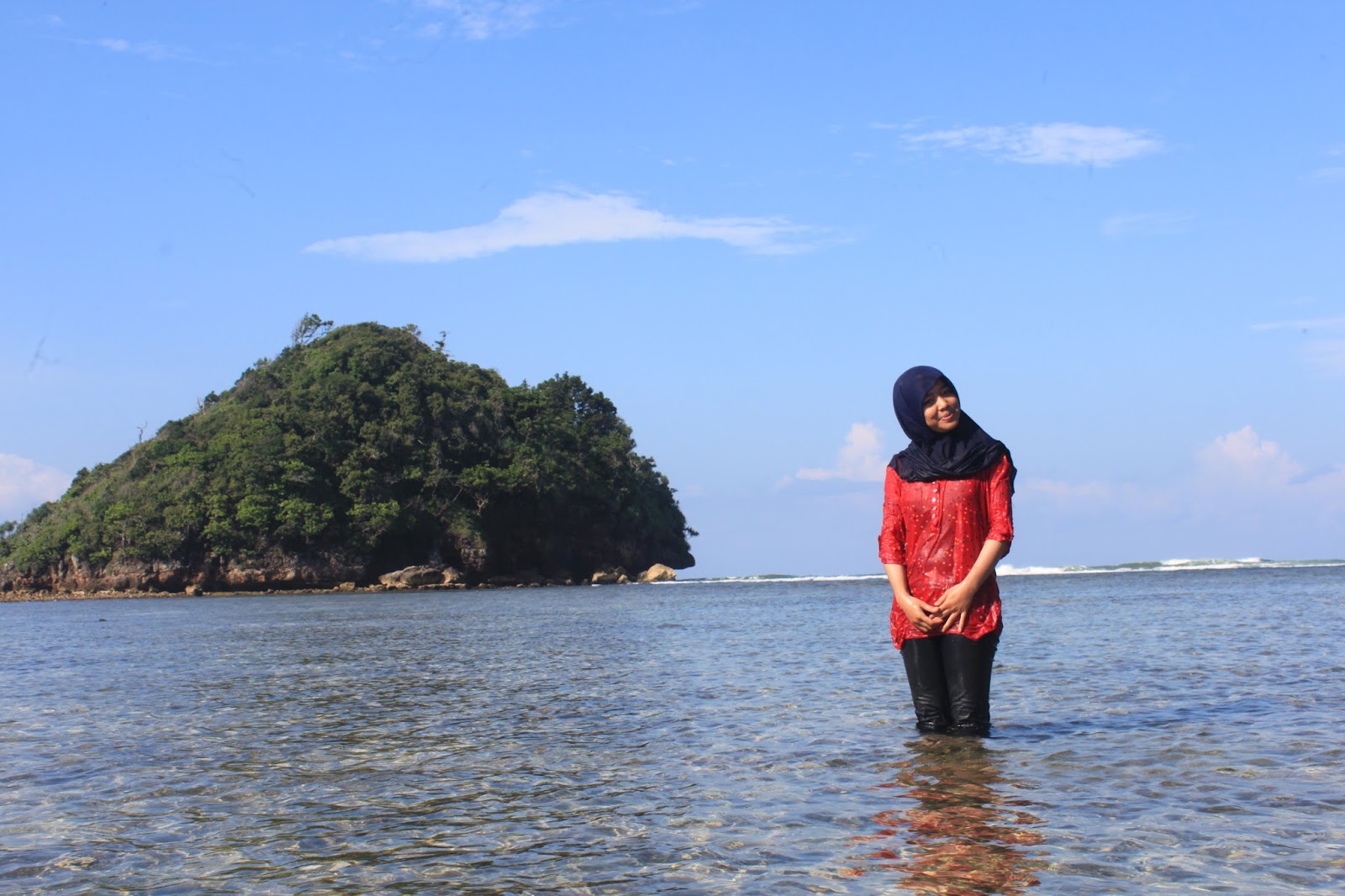
Paginya semua keliatan indah, langit kuning emas cantik, pasir yang bersih, bakau yang berjejer rapi, dan sungai air payau yang jernih. Kita udah nggak sabar pengen mandi, dan akhirnya kita mutusin naik bukit sampe nemu pantai Gatra, ini pantai yang gue nobatin jadi pantai favorit sampe sekarang.  Seru-seruan di pantai gatra, mulai dari mandi, berenang, sampe main pasir. Kita lanjut ke pantai tiga warna. Kita kesana dianterin tour guide. Lumayan naik turun dan agak jauh. Pas ngeliat pantai tiga warna yang sumpah keren banget kita udah lari-larian nggak jelas kaya ayam lepas. Ainy, Lalank, Hanis, Dwiki main snorkling, aku sama yang lain foto-foto dan main air.
Perjalanan ke pantai semingguan ini seru, karena gue ditemenin orang-orang seru. Orang yang nggak ribet ini-itu. Intinya, kalo menurut aku main emang lebih asyik kalo tanpa rencana, karena sepengalam gue kebanyakan rencana malah nggak jadi. Kaya waktu kita ngerencanain ke Bromo sama tim PKM UMengajar. Teman yang nggak ribet dan nggak baperan membuat kita nyaman, meskipun waktu pulang dari pantai kita sempat gemeteran. Laper. Ya maklum, ke pantai cuma modal kacang kulit sama pilus. Ini serius. Jangan ditiru di pantai.


Ini loh, pasukan edan yang mau menginvasi pantai selatan
Pantai Clungup


Pantai Gatra

Pantai Tiga Warna


 Lihat juga hanis yang lagi promo iklan duta wisata di https://www.youtube.com/watch?v=15PpoxFzySk


Minggu, 17 Januari 2016

Gender Stereotypes in Jane Austen’s Pride and Prejudice


Bannet's Daughters

Jane Austen was an England Novelist. She was born in Stevenson, Hampshire, England on December 16, 1775. Austen was from a small family who appreciated knowledge and took interest in reading so that she become a famous author. Among her masterpieces are Sense and Sensibility in 1811, Pride and Prejudice in 1813, Mansfield Park in 1814 and Emma in 1816, Northanger Abbey and Persuasion in 1818. Her works were paying attention in social condition, morality, education, marriage, and feminism. In fact, she was a very well-known novelist until this current century.

This article is going to present the analysis one of Austen’s novels. It is Pride and Prejudice. The writer is interested in the novel because Pride and Prejudice was a very popular novel until today and so many critics toward this novel. Also, this novel was full of gender issues and stereotype that the author wrote as the act of social critic during the Jane Austen’s life. 

Pride and Prejudice novel brought the story about an upper-middle class family in England. The time in the novel reflect in the early 19th century. Pride and Prejudice tells a story about The Bannet’s family. They consists of father, mother, and five young daughters. The problem figured out by the family is the lack of a son so if Mr. Bannet were to die, all of his money and property would pass to a male cousin in the family, Mr. Collins. That is why, Mrs. Bannet, the mother puts all of her energy into marrying her daughters off to respectable men with a respectable fortunes. The girls’ only purpose in life is to find a husband and marry, which is reflected by the tradition of girls ‘coming out’ into society. 

The main characters in Pride and Prejudice are Elizabeth Bannet. She was the second daughter of Mr. and Mrs. Bannet. She was described by the author as an intelligent, lively, playful, and attractive lady. However, she had a tendency to judge people on a first impression. As it is reflected in the title ‘prejudice’. Based on Longman Dictionary Advance (2016), the word ‘prejudice’ means unreasonable dislike of people who are different in some way. The second character is Mr. Darcy. He was a protagonist-twenty-eight-year old unmarried man. Austen described Mr. Darcy as a handsome, tall, and intelligent person. However, he was put his pride highly due to all the prosperity he had. The next character in this novel is Mr. Bannet, the father of five daughters. He has an ironic and cynical sense of humor that irritates his wife. As it is stated in chapter 1,
Mr. Bennet was so odd a mixture of quick parts, sarcastic humor, reserve, and caprice, that the experience of three-and-twenty years had been insufficient to make his wife understand his character. Her mind was less difficult to develop. She was a woman of mean understanding, little information, and uncertain temper. When she was discontented, she fancied herself nervous. The business of her life was to get her daughters married; its solace was visiting and news. (Chapter 1, the last paragraph)
Unlike his wife, Mrs. Bannet, who was frivolous, excitable, and narrow-minded. His main ambition in her life is to marry her daughters to wealthy men. However, she did not really put attention whether or not the daughter happy with such a match she arranged. Jane Bannet was the eldest daughter in Bannet family. The author, Jane Austen described her as the most beautiful young lady in the neighborhood. She was sweet, shy, and sensible. She was favored by her mother due to her beauty. In the story, she fell in love with Mr. Charles Bingley, a rich man who had recently moved to Hertfordshire and a close friend of Mr. Darcy. Charles Bingley is a handsome, good-natures, and wealthy young gentlemen. His nature was very different with Mr. Darcy. As he was very charming, king, and had a pleasant manner.

The stereotypes emerge in the story are woman powerless, gender superiority, and patriarchy. Firstly, about woman powerless which are found in the novel are during the conversation between Mr. and Mrs. Bannet we can see that the Mr. Bannet was under the rule of her husband and unable to do certain things without him. Mrs. Bennet acknowledged this social rule when she argued with her husband about visiting Mr. Bingley. She said that, ‘…it will be impossible for us to visit him if you do not’ (Chapter 1). Second evident of woman powerless is in the conversation between Charlotte and Elizabeth ‘"I see what you are feeling," replied Charlotte. It is portrayed women hang their happiness on their husband and marriage. Furthermore, it is clearly reflected that marriage is something that can save their pride.
"You must be surprised, very much surprised - so lately as Mr. Collins was wishing to marry you. But when you have had time to think it over, I hope you will be satisfied with what I have done. I am not romantic, you know; I never was. I ask only a comfortable home; and considering Mr. Collins's character, connection, and situation in life, I am convinced that my chance of happiness with him is as fair as most people can boast on entering the marriage state." (Chapter 22).


The second gender stereotype emerges in the story is about the gender superiority. It is describe in the first chapter that Mr. Bannet has five daughters and has no son so that all his property and money cannot be given to his daughter. Instead, the one who will inherit all his wealthy is Mr. Collins, his cousin. It is obvious that woman has no strength to take role as an heir. Moreover, men, at that time, are very superior and women are inferior.

The second gender stereotyoe that the story brings is about the patriarchy. Patriarchy is a social system in which males hold primary power, predominate in roles of political leadership, moral authority, social privilege and control of property. In the domain of the family, fathers or father-figures hold authority over women and children. It is captured in the story that Mr. Bannet holds the importat role as the head of his family. Moreover, he is one who makes every decision for his family. Elizabeth was also under the rule of Mr. Bennet, her father. When Mrs. Bennet wanted Lizzy to marry Mr. Collins, she appealed to Mr. Bennet. ‘You must come and make Lizzy marry Mr. Collins…’ (Chapter4). If Mr. Bennet had told Lizzy to marry Collins, she would have had no choice in the matter. Also, Mrs. Bannet thought that Elizabeth would change his mind after her father’s insitisted her to marry Mr. Collins although she did not. Thus, men were still seen as the ones who gave commands, while the women obeyed them.

Women’s role is also potrayed in the story. The highlited one is Mrs. Bannet role in her family. She, as a wife, has five young unmarried daughters seems very busy make her daughters marry to a fortune man. She put all of her energy to arrange her daughter marriage. It is stated in Chapter 1 and 3 shows that Mrs. Bannet role as a good wife and a good mother is to make sure that all of her daugters will be married to a respectable man with respectable fortune.
"Oh! Single, my dear, to be sure! A single man of large fortune; four or five thousand a year. What a fine thing for our girls!" (Chapter 1)
"If I can but see one of my daughters happily settled at Netherfield," said Mrs. Bennet to her husband, "and all the others equally well married, I shall have nothing to wish for." (Chapter 3)

Elizabeth is symbolized the changes in the role of women in society. When she spoke her mind, it sometimes was not accepted by the people around her. It was so far different from other women’s characters in the story such as Mrs. Bannet and Lidya Bannet who still followed traditional role. She was a strong wild young woman and would not acquiesce to the desires of Mr. Collins or Mr. Darcy when the two men proposed. Lizzy spoke her mind and wasn’t afraid to make anyone, man or woman, angry. She was literate and could also write; showing that she had had some form of education. Furthermore, when Jane was invited to come to Mr. Bingley house, Mrs. Bannet forced Jane to come in order to get attention from Mr. Bingley. Mrs. Bannet did not think any risk could get her favorite daughter as at the story tell that it was hard rain.
Elizabeth's spirits soon rising to playfulness again, she wanted Mr. Darcy to account for his having ever fallen in love with her. (Chapter 60)

Mr. Darcy is symbolized as the powerful man. As he could run the estate after the death of his father. Moreover, Austen explain that Mr. Darcy was a man with a high pride so that he rarely danced with a any lady. He just danced with Mrs. Hurst and Miss Bingley; both of them are ladies from upper class. Furthermore, Mr. Darcy was very sarcastic to Lizzy for giving his sharp statemet about her.
He was the proudest, most disagreeable man in the world, and everybody hoped that he would never come there again. (Chapter 3)
"Which do you mean?" and turning round he looked for a moment at Elizabeth, till catching her eye, he withdrew his own and coldly said: "She is tolerable, but not handsome enough to tempt me; I am in no humour at present to give consequence to young ladies who are slighted by other men. You had better return to your partner and enjoy her smiles, for you are wasting your time with me." (Chapter 3)

Furthermore, symbol of powerful man reflected by the existence of Mr. Collins who come to find a wife. He could choose a wife as he want although he was refused by Lizzy. Mr. Collins finally married to Charlotte, a close friend of Lizzy. Charlotte married to a man who had already owned his property so that she did not need to work. Women at that time did not work but the men as a husband would.


Jumat, 11 Desember 2015

Interval: Bentuk Penghormatan pada Otak dan Tubuh


Hebat memang punya banyak kegiatan itu, memulai proker-proker baru dan selalu punya kesibukan untuk dikerjakan. Kita merasa berarti, sibuk, dan bertanggungjawab atas sesuatu.

Kita sering beranggapan kepada diri sendiri kalau kita sudah sibuk banget. Begitu juga dengan orang lain, kadang kita berideologi bahwa kita adalah kelompok orang-orang yang penting, punya tugas, dan punya tanggungjawab. Tidak bisa dipungkiri juga kalau kita sering merasa kehidupan yang kita jalani adalah lebih bermanfaat dan lebih bermutu dari pada yang orang lain lakukan. Tidak juga bisa dipungkiri bahwa fanatisme juga mulai menggerogoti perasaan. Bahwa organisasi atau pekerjaan yang kita tekuni adalah lebih baik dari apa yang dimiliki orang lain.

Kita lupa tujuan utama organisasi atau pekerjaan kita.

Makanyalah, perlu waktu yang lama untuk memulihkan pikiran, perasaan, dan fisik. Meskipun, jelas, bahwa semua pekerjaan dan organisasi jalani akan memberi banyak manfaat entah dalam jangka pendek, menegah, atau panjang. Tapi, ada saatnya kita perlu bersantai sejenak, bukan untuk melupakan, tapi untuk mempersiapkan diri dan pikiran, sehingga saat kita memuali bekerja lagi, akan lahir ide-ide baru nan segar.

Seperti yang aku lakukan beberapa hari ini, aku lebih banyak menghabiskan waktu untuk tempat tidur, kasur, film, dan musik. Lega rasanya untuk jauh sebentar dari rutinitas. Meskipun sempat berfikir bahwa sebenarnya bukan badan yang harus di charge ulang, melainkan psikis dan mental. Sehingga kasur dan kawan-kawannya itu acapkali justeru membuat kesal tidak tahu asal-usulnya. Rasanya, orang-orang tipe-tipe aku ini memang lebih cocok dengan pantai, gunung, tebing, dan pemandangan alam lainnya. Yang pasti, itu semua adalah bagian dari pilihan. Sebuah interval sebagai bentuk Penghormatan pada Otak dan Tubuh.

Ini cuplikan jalan-jalan ke gunung beberapa waktu lalu:


Selamat berlibur, selamat 'membersihkan otak'.

Selasa, 08 Desember 2015

Surabaya Part #1

Jadi sekitar pertengahan bulan Nopember lalu, aku sempat berencana ngilang sebentar. Satu, karena jenuh sama rutinitas PPL yang emang barusan selesai. Dua, karena aku sempat mikir, aku nggak akan pernah merasa cukup kalau cuma stuck disini aja. As world know lah, aku ikutan organisasi yang orang-orangnya ya masih sama itu-itu aja. Asik sih, cuma kudu dan udah masanya keluar dari zona aman dan nyaman.

Seminggu setelah lolos pengumuman kegiatan peace camp di Mojokerto, aku excited banget karena udah geregetan pengen keluar dari Malang. Langsung cus bayar registrasi make uang dari ATM rossy, yang emang notabene kudu ngirim lewat Bank Mandiri. Jujur, setelah PPL berakhir, itu justeru awal ke-bokek-an tingkat galaxy dalam sejarah perkuliahan. Haha, uang kiriman udah habis buat bikin media, ngasih oleh-oleh anak-anak selama PPL, but that's OK.

Bokek is just a little story of a survivor life.

Beberapa hari sebelum berangkat ke Surabaya, aku bolak-balik ke stasiun buat beli tiket. Tapi, for your information, kalau sekarang tiket lokal dapat dibeli mulai dari tiga jam sebelum keberangkatan. Ya kali, aku udah hampir setahunan nggak naik kereta, terakhir naik itu waktu pergi ke Depok buat konferensi nasional gerakan mengajar. Nah lo, jadi mondar mandirnya ke stasiun agak nggak guna.

Jadwal kereta dari Malang ke Surabaya tepat pukul 04.30 pagi, waktu itu aku diantar teman kontrakan jam 4 pagi. Hemm, Malang bener-bener keren pagi dari paginya, siangnya, sorenya, sampai Malangnya. Keren. Sampai di Stasiun jam 4.15 dan masih nunggu Anissa, adik tingkat yang ternyata juga ikutan acara yang sama. Lama banget nunggu anaknya sampe dimarahi sama petugas kereta karena emang kereta udah mau naik. Akhirnya, aku naik dan masuk kereta. Si Anisa menyusul kemudian. Terpaksa kita beda gerbong dan harus duduk sendiri. Ngantuk banget, yaudahlah, aku sempatin tidur sebentar.

Sampe di Surabaya jam 7 pagi, ketemu lagi sama Anisa di peron, dan sms panitia tanya harus naik apa untuk menuju UIN Sunan Ampel (UINSA) Surabaya. Kata Ce Carol, kita harus naik angkot warna kuning tujuan UINSA. Esumpaaah, guwe setengah buta warna. Jadi please, jangan nunjukin aku clue pake warna dan if you know angkot di Surabaya warnanya kuning semua. Sumpah. Guwe buta warna. Akhinya keluar stasiun dan nanya sopir angkot. Angkonta lewat UINSA atau enggak. Pas aku nanya, bapaknya cuma nganguuk-ngangguk aja. Udah stengah perjalanan si Anisa nanya, "Pak ini angkot beneran lewat UIN Sunan Ampel,kan?" Lha dalah, sial. Sial banget. Bapaknya bilang tadi dengernya makam sunan ampel, bukan uin sunan ampel. Njirr, udah setengah jam ngangkot dan salah. Akhirnya, bapaknya baik banget dan nyariin angkot yang menuju tujuan kita.

Sampe disana jam 8 dan kita udah ditungguin sama Ce Carol dan peserta lain yang udah nunggu di dalam minibus. Karena aku emang kloter terakhir, jadi emang udah nggak usah nunggu lama-lama, kemana? Yap. Kita cus ke Mojokerto, tempat pelaksanaan acara. Jarak Surabaya ke Mojokerto ditempuh dalam dua jam lamanya, panas, bau jalan, dan sumpah ngantuk. Yaudah, dari pada nyiumin bau asap kendaraan, mending tidur, lumayan dua jam. Haha.

Sampe di Maha Vihara Mojokerto duah mepet jam 10, karena jalanan macet parah. Nggak pake basa basi,langsung pembukaan acara. Ketemu teman-teman baru. Beneran, itu seru. Setelah pembukaan acaranya langsung pembagian kamar, dan kebetulan se kamar sama Yanita, Sofi, Desi, dan beberapa teman dari Lombok cc Faridah dan Samina. Mojokerto panas gila, akhirnya sebelum dzuhur bisa mandi.

Selema ikutan peace camp dan ketemu teman-teman baru, makan seadanya, bertukar pikiran tentang kepercayaan masing-masing, team building, energizer, sampai moment paling mengharukan yaitu ikutan reconciliation menu. Dimana masing-masing peserta ngungkapin stereotype mereka tentang agama lain waktu itu dan moment saling meminta maaf, nangis, dan pelukan. Semuanya jadi saudara sekarang. Alhamdulillah.

Nih, beberapa foto yang sempat aku ambil dari google drive Peace Camp kemarin.
Adegan Jelly Fish yang berhasil bikin Ko Anjo ikutan joget haha

Foto bareng setelah olah raga pagi

Waktu kita berikrar buat tegas menolak kekerasan, itu wajah setelah perang koran.
Yang item namannya Ahmad Sari, yang merah namanya Dita
Nih, habis rekonsiliasi

Foto sama panitia YIPC di Maha Vihara Mojokerto
Budha tidurnya keren banget


PS: Jauh dari rumah, jauh dari teman lama, jauh dari rutinitas kebiasaan emang mengasyikkan. Tapi, beneran, nggak bakal ada tempat satupun di dunia ini yang bakalan bisa nggantiin rumah. Artikel ini ditulis saat kangen rumah.

Rabu, 11 November 2015

Ngadas, Desa Romantis di Atas Awan


Indonesiaku, multikultural katanya.
Kaya akan budaya, bahasa, adat, dan agamanya.
Penduduknya percaya sekali dengan surga dan neraka.
Namun, kadang yang kulihat bukan ibadat mereka.
Tapi saling berperang tentang surga siapa.
“Itu dongeng kan, Kak. Bukan nyata?”, tanya mereka.
           
 Pada mana aku tak takjub, kalau mereka yang hidup dalam kesederhanaan bisa sedalam amat memegang teguh toleransinya. Harus dengan cara apa lagi aku mengagumi, sekelompok penduduk yang menamai diri mereka Suku Tengger, dengan pipi merah, mata coklat bening, dan alis tebal yang khas. Dikurung dinginnya udara dari pagi sampai malam hari pun, namun mampu hidup dalam dalam hangatnya toleransi dan tenggangrasa yang begitu dijunjung tinggi. Merekalah penduduk, petani, pengojek pupuk, pengepul kentang, pemandu wisata, penjual edelweis dari desa sebuah tertinggi di pulau Jawa, Ngadas.
            Sudah satu tahun ini, aku mengenal desa ini. Tepat 8 November, tahun lalu, aku bersama teman-teman dari gerakan UMengajar menginjakkan kaki pertama kali di tempat ini. Aku masih ingat, satu rombongan kami sampai di tempat ini sudah menjelang isya, sehabis hujan. Dingin, sudah pasti. Terlihat beberapa anak berbaris di teras tempat kami akan menginap malam itu. Sungguh, itu sambutan terhangat dari anak-anak yang pernah kutahu. Aku pun terusik penasaran, akan nama mereka, dan mengapa sengaja berdiri di tempat itu. Jawabnya sungguhlah haru, mereka menunggu para kakak yang esok hari akan menemani mereka belajar dan bermain.
            Malam menjelang, heater-heater kami sudah terisi air dan dinyalakan, untuk sekedar mengisi dan menghangatkan perut sambil demo pembelajaran untuk esok hari. Larut dalam tawa diiringi dengan kremesan mie instan goreng yang masih mentah lengkap dengan bumbunya untuk santapan ternikmat ala-ala anak survival kekinian. Larut malam Ngadas pun, sanggup membuat kami bertahan tidur beralaskan lantai dengan suhu yang bisa dikatakan ‘dingin keterlaluan’. Dan aku merasa beruntung, bahwa dalam melakukan hal-hal romantis di tempat yang romantis itu, aku tidak sendiran.
Orang-orang Tengger
            Dan 7 November tahun ini, tepat satu tahun aku mengenal Ngadas. Tapi ya entah sejak kapan, aku jatuh cinta pada tanah romantis ini. Tanah yaang penuh dengan segala doa-doa kebaiakan dari tiga agama yang hidup berdampingan. Tanah yang dipenuhi harapan-harapan, yang kelak akan lahir dan besar dari sebuah sekolah sederhana bernama SDN Ngadas 1 dan SMP Satu Atap. Karena bagiku masih sama, bahwa sekolah adalah ladang setiap pengharapan baik. Baik dari guru, orang tua, pimpinan adat, dan boleh jari kami. Sekumpulan mahasiswa yang belum sepenuhnya hadir dalam motivasi setiap anak-anak yang kami dampingi proses belajarnya, setiap sabtu, setiap minggu.
            Mungkin tidak berlebihan jika suatu hari, aku ingin meletakkan gambar Desa Ngadas, orang-orang Tengger lengkap dengan sarung-sarung untuk menghangatkan badan mereka, dan ladang-ladang kentang yang membentang di dalam rumahku kelak. Entah berlebihan atau kurang, jika cita-citaku mengenalkan Ngadas pada orang-orang di luar sana atau sekedar meyakinkan banyak orang tentang eksistensi ciptaan Tuhan di tanah yang berada di ketinggian 2200 di atas permukaan air laut Malang. Atau bisa saja, mereka yang masih sering membeda-bedakan, radikal, apatis, bahkan intolerant sebentar saja ditolehkan kepalanya, sekedar melihat dan belajar bagaimana 2000 orang di desa itu hidup dalam keharmonisan.
Siswa Ngadas
© Kolase Random | Blogger Template by Enny Law